
Basement Mold Removal for Damp, Finished, and Water-Damaged Basements in St. Louis
Basements collect moisture. They sit against the soil, they hold plumbing, laundry, and mechanical equipment, and they're the first place water goes after a heavy rain. When moisture lingers, mold follows, on wood paneling, insulation, carpet, drywall, stored boxes, and the walls behind them. Our basement mold removal team in St. Louis, MO cleans up visible mold, opens finished walls when we need to see what's behind them, and finds the moisture that let the growth take hold. Sansara 24/7 Restoration & Remodeling is locally and family owned, based in Wildwood, and we answer the phone any hour.
Most basement mold calls come down to one question: where is the water coming from? It may be seepage through a foundation wall, a plumbing leak, high humidity, or a flood that dried on the surface but not underneath. Until that's answered, cleaning is a temporary fix. So we look for the source, take moisture readings across the space, and explain what's cleaned, what's removed, and why.
If the mold followed a leak, a storm, or a flood, our water damage restoration team handles the water side of the job, so the drying and the mold cleanup are planned together instead of in two separate stages.
If your basement has standing water right now, that comes first. Our basement flooding team extracts the water and starts drying so the mold work doesn't have to fight a wet space.
Common Causes of Basement Mold
Basements pick up moisture from several directions at once. These are the usual causes:
Seepage through foundation walls and floor cracks, especially after heavy rain
Flooding from storms, sewer or drain problems, or window wells that fill up
Sump pump failure, which leaves water sitting or backing up
Plumbing leaks from supply lines, drain lines, water heaters, and washing machines
High humidity in a space that doesn't get much airflow
Wet carpet or padding that never fully dried
Wall cavities in finished basements, where moisture gets trapped behind the drywall
After a flood, timing matters. Carpet, pad, drywall, and cardboard that stay wet give mold what it needs, so getting water out and materials dry quickly reduces how much mold you end up dealing with. It doesn't remove the risk entirely, which is why we check moisture afterward instead of assuming a basement is dry.
In finished basements, the cause can be hidden for a long time. A small leak behind a wall can keep insulation and drywall damp for months before there's anything to see.
Signs Mold May Be Growing in Your Basement
Some signs are obvious, and some only show up when you know to look:
A musty odor, especially when you first walk down the stairs
Staining or spotting on walls, ceilings, or the bottom of the wall
Peeling or bubbling paint
Damp, discolored, or crumbling drywall
Carpet that smells or feels damp
Visible growth on wood, paneling, boxes, or stored items
Condensation on windows, pipes, or walls
A basement that stays humid even when the weather is dry
If you see any of these, don't wait for the smell to reach the floors above. Mold that's caught early is a smaller job.
Our Basement Mold Removal Process
Every basement is different, but the process stays consistent, and it follows the same steps as our full mold remediation process, sized to the space. Most of the work happens downstairs, and you can usually stay in the house. We work around your furnace, water heater, and other mechanical equipment, and we tell you up front if anything needs to be protected or moved. Here is how we handle it.
Inspection and Moisture Readings
We walk the basement, look at the visible growth, and use moisture meters to read the walls, floor, and framing. We check for the source: seepage, leaks, condensation, or water from a past event that wasn't fully dried. We photograph what we find, and we explain what it means before we start.
Containment
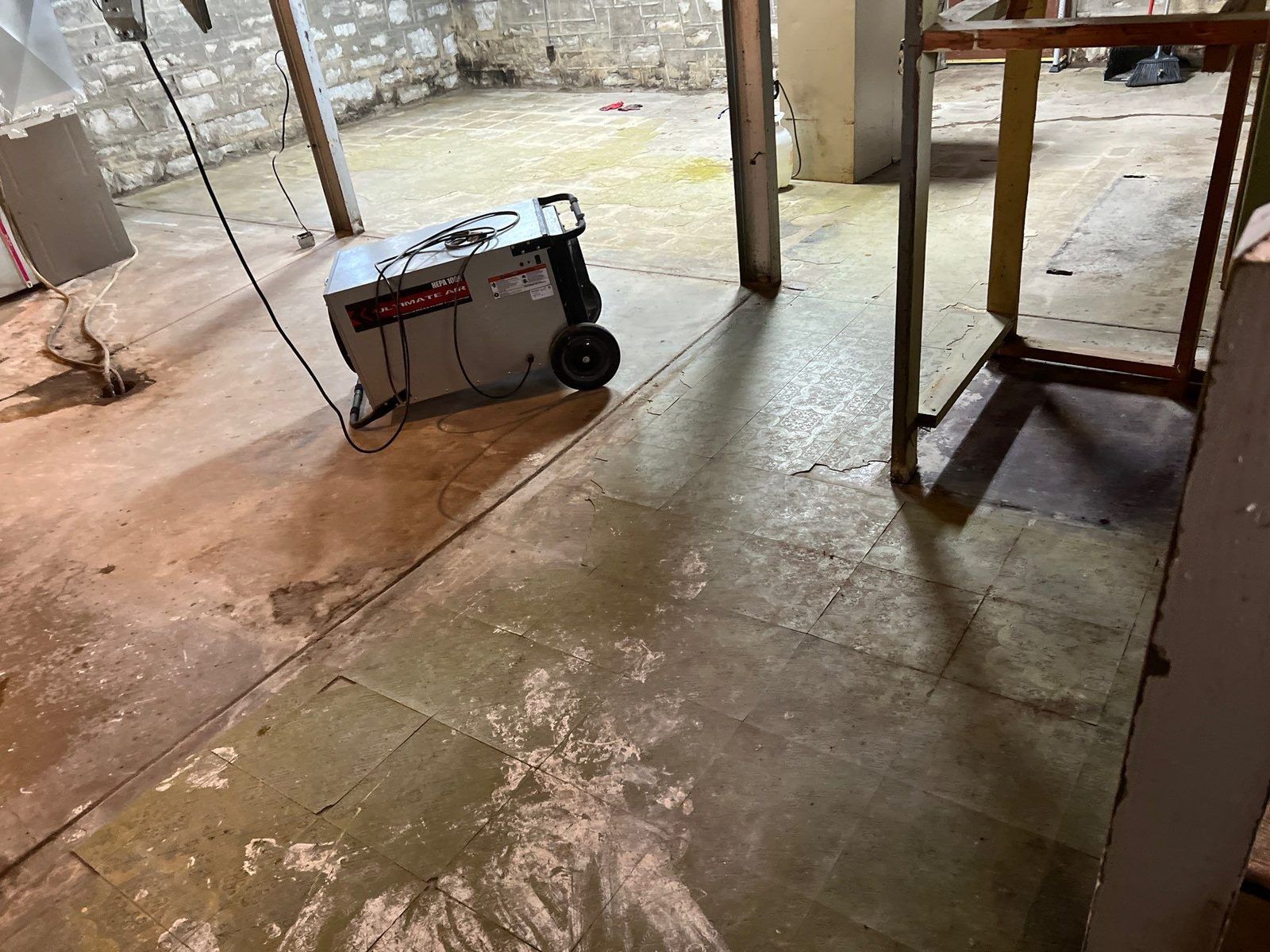
We isolate the work area so dust and spores don't travel up the stairs and into the rest of the house. Where the scope calls for it, we run HEPA air filtration during the work.
Removal of Damaged Porous Materials
Moldy drywall, insulation, carpet, carpet pad, and wood paneling that can't be cleaned reliably are removed and bagged to limit the spread. Stored items are a common problem here. Cardboard boxes, fabric, and paper absorb moisture and hold mold, so if you have things in the basement, ask us before carrying them through the house. Opening the walls lets us see the framing, find growth that would otherwise stay hidden, and clean it properly.
Cleaning Salvageable Surfaces
Concrete, block, framing, and other solid surfaces can often be cleaned rather than replaced. We HEPA vacuum and clean them, and we treat the surfaces we've cleaned.
Drying and Dehumidification
After cleaning, we use air movers and dehumidifiers to dry the space and take moisture readings to confirm materials have dried. Our structural drying page explains how we monitor moisture in framing and floors so we aren't guessing.
Prevention Recommendations
We tell you what we found and what needs to be fixed, such as leaks, drainage, a failing sump pump, or a humidity problem. If a plumbing leak is the source, a plumber will need to repair it, and we handle the water damage and mold. Fixing the source is what reduces the chance that mold comes back.
Finished vs. Unfinished Basement Mold
The finish level changes how we approach the job.
Unfinished basements have concrete or block walls and exposed framing, which are easier to reach and often easier to clean. Concrete is porous in its own way, but it can often be cleaned and dried. The main concerns are stored items, wood framing, and whatever moisture is coming through the walls or floor.
Finished basements are harder, because mold can grow behind the surfaces. Drywall, insulation, carpet, and paneling are porous, so if they've been wet, they usually come out. We open walls to look behind them, remove what's affected, and clean the framing. Stored belongings should be moved out of the way, and if a larger job calls for it, our pack-out services can inventory, pack, and clean contents.
Once the space is clean and dry, you can rebuild it, and we can help with that too. Our reconstruction services handle the repair, and if you'd like to update the space while you're at it, our basement remodeling team can finish it.
Schedule Basement Mold Removal in St. Louis, MO
If your basement has flooded, leaked, or started to smell, call us before the problem spreads behind the walls. We'll look at the space, find the moisture, and explain what removal would involve. Call (636) 812-3838 any hour. If you're not sure how far the problem goes, a mold inspection can define it first.