
Basement Flooding Cleanup in St. Louis, MO
Sansara 24/7 Restoration & Remodeling provides basement flooding cleanup in St. Louis, MO for finished and unfinished basements affected by storm water, sump pump failure, plumbing leaks, sewer backups, foundation seepage, and appliance failures. We focus on fast water removal, safe drying, humidity control, protecting your belongings, and reducing the risk of mold.
A basement is one of the hardest places in a house to dry. It sits below grade, it is made of concrete and block that hold moisture, and it has little natural airflow. Water that would dry out of an upstairs room in a few days can linger for much longer down there, which is why a flooded basement needs a plan and not just a wet vac. This work is part of our broader water damage restoration services.
We answer 24/7 and get a crew moving when you call (636) 812-3838. If the water is deep or near the electrical panel, stay out of the basement until the power is off. While you wait for the crew, take photos of the water level and the damage, and carry up small valuables and papers only if it is safe to do so.
Common causes of basement flooding
Basements flood for many reasons, and the cause changes how we clean up. The ones we see most often are:
Heavy rain and saturated soil that push water through the foundation
Overflowing window wells and stairwell drains
Cracks in the foundation or seepage where the floor meets the wall
Sump pump failure, often during the same storm that causes the flooding
Sewer backups and overwhelmed floor drains
Plumbing leaks, including burst pipes and failed supply lines
Appliance failures, such as a water heater or washing machine in the basement
The question we ask first is whether the water was clean or contaminated. Clean water from a broken pipe is handled differently from storm water or sewage. We also ask how long the water has been there and how deep it got, whether the sump pump is running, and whether anyone has used plumbing fixtures since the flooding started. Answers to those questions tell us whether we are dealing with a one-time event or a source that is still active.
Fixing the cause of the flooding, such as waterproofing, foundation repair, grading, or plumbing, is not work we perform, so that part goes to the right trade. We handle the water in your basement and everything it soaked. Once the standing water is out, our water extraction work takes over from there.
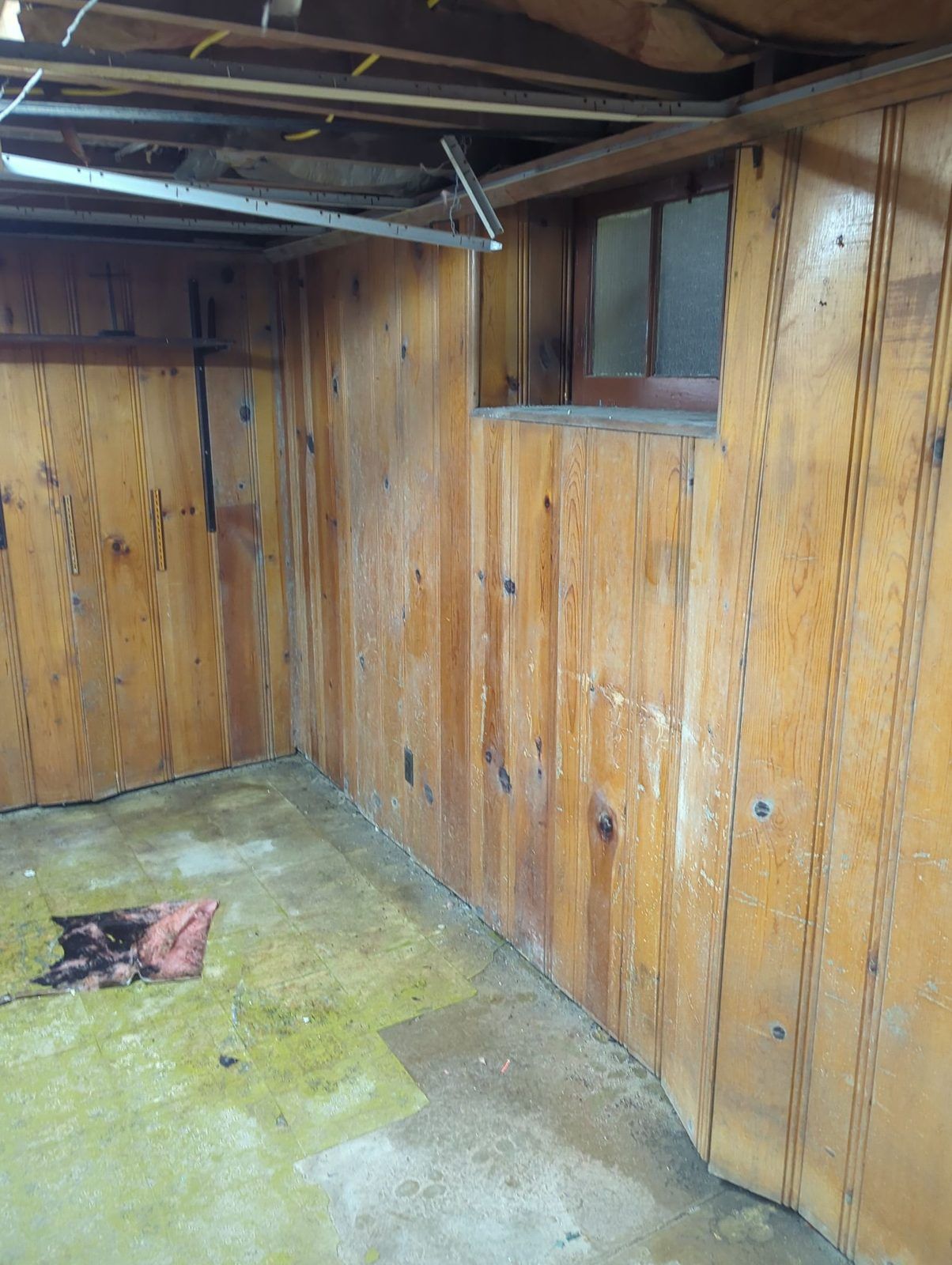
Water removal, drying, and moisture monitoring
Flooded basements are handled in a set order, and each step depends on the one before it.
We begin with safety. We check for electrical hazards, look for signs the water is contaminated, and decide what protective equipment the crew needs. Then we remove the water. Pumps handle deep standing water, and extractors take up water from carpet and hard floors. Getting the bulk of the water out quickly limits how far it spreads into walls and stored belongings.
Next, we remove materials that cannot be dried safely, such as wet carpet pad, saturated insulation, and drywall that has wicked water up the wall. That opens the space so it can dry. We then set air movers and dehumidifiers and monitor them with moisture readings at each visit. Concrete and block release moisture slowly, so basements often take longer to dry than other areas, and we do not name a drying time before we have inspected the space.
Throughout the job, we record moisture readings, take photos, and keep notes on the materials we remove and why. If you are working with your insurance company, that record gives you organized information to share, and we work with your insurance company by answering questions about what we found and did. We cannot say what your policy covers.
If the water came from a drain or a sewer line, we treat it as contaminated from the start, and our sewage cleanup work applies. In that case, anything porous the water touched usually has to be removed, and what remains is cleaned and sanitized before drying continues.
Finished basement materials and contents risks
A finished basement has more to lose than an unfinished one. Drywall, insulation, carpet and pad, wood trim, cabinets, and flooring all soak up water, and the framing behind them stays wet long after the surface looks dry.
What can stay and what has to go depends on the type of water, how long it sat, and how saturated each material got. Carpet pad, insulation, and soaked drywall usually come out. Solid wood trim, concrete, and framing can often be cleaned and dried in place. Laminate and particleboard swell and are usually not recoverable. We check each material with a moisture meter and explain what we recommend, and we do not promise that a finished basement can be saved sight unseen.
Belongings are at risk too. Cardboard boxes, papers, fabric, and anything stored on the floor absorb water fast. When contents need to leave the basement, our pack-out services inventory, pack, move, and clean them. If the basement flooded from a storm or groundwater, the water is treated as contaminated, and the same rules apply as in our flood damage restoration work.
Once the space is dry and the damage is cleared out, we can rebuild it with our reconstruction services. If you want to finish or update the basement while it is open, our basement remodeling team can take that on as well.
Sump pump failures, sewer backups, and floor drains
Two of the most common causes of basement flooding are the ones that fail in the middle of a storm.
A sump pump can fail from a power outage, a clogged intake, a stuck float switch, or simply because it was overwhelmed by the volume of water coming in. When it stops, the pit fills and the basement follows. If that has happened to you, our sump pump failure cleanup work covers removing the water and drying what it soaked. The pump itself needs to be repaired or replaced by someone else before the next storm.
A sewer backup or a backed-up floor drain sends contaminated water into the lowest part of the house. Do not use sinks, toilets, or showers while water is coming up from a drain, since that can add to the flooding. Call us for the water, and call a plumber to clear the line. The water that came up is Category 3, and our sewage cleanup covers removal of the water, removal of what it soaked, and careful sanitizing.
In either case, drying comes next. The structural drying process is what brings walls, floors, and framing back to normal levels, and we record the readings so you can see it happen.
Mold prevention after basement water damage
Basements start out with more moisture than most rooms, so a flood raises the risk of mold. What lowers it is speed and thorough drying: removing standing water quickly, taking out materials that will not dry, running air movers and dehumidifiers, and continuing to take moisture readings until materials are back to normal levels.
We reduce the conditions mold needs, but we cannot guarantee it will not develop. It depends on how long the water was there, what it was carrying, and how dry the space stays afterward. Afterward, you can help by keeping basement humidity low and checking for musty smells, dark spots, or damp corners over the following weeks.
If you already see visible mold or notice a musty odor that will not go away, that is a job for our mold remediation team. Our basement mold removal work covers growth that is already established, and it is handled as a separate scope from the flood cleanup.
Call Sansara 24/7 Restoration & Remodeling for basement flooding in St. Louis, MO
If your basement is flooded, do not wait for the water to go down on its own. Call Sansara 24/7 Restoration & Remodeling for basement flooding cleanup in St. Louis, MO. We remove the water, clear out what cannot be saved, dry the space, and document the job so you can move on to repairs.
We are locally and family owned, based in Wildwood, and fully insured, and we answer every call at any hour. Estimates are free. Call (636) 812-3838 now, or use our contact form if the water is gone and you need an assessment.