
Structural Drying Services in St. Louis, MO
Sansara 24/7 Restoration & Remodeling provides structural drying in St. Louis, MO after water damage reaches framing, drywall, subfloors, cabinets, walls, ceilings, and the cavities between them. Structural drying is the controlled removal of moisture from your building's materials, using air movement, dehumidification, and regular moisture readings until those materials are back to normal levels.
Removing standing water is not the same as drying the building. Water soaks into materials that feel dry to the touch, and moisture left there leads to warped flooring, peeling paint, odors, and mold. Structural drying is the phase of water damage restoration that deals with that hidden moisture, and it is where a lot of the difference between a smooth repair and a repeat problem is made.
We answer 24/7 and get a crew moving when you call (636) 812-3838. The sooner drying starts, the fewer materials tend to need replacing.
What structural drying includes
Structural drying begins during water mitigation, as soon as the standing water is out, and it continues until the readings tell us the job is done. A typical drying job includes:
Moisture readings to find what is wet and to build a drying plan around what we find
Air movers that push dry air across wet surfaces and into wall cavities
Dehumidifiers that pull moisture out of the air so it does not settle back into the materials
Containment, such as plastic sheeting, where it helps keep the drying focused on the wet area
Removal of materials that cannot be dried safely
Monitoring visits, with equipment moved and adjusted as materials dry at different rates
Drying logs and readings that document the job from start to finish
No two drying jobs are the same. A hardwood floor, a wall packed with insulation, and a set of particleboard cabinets all release moisture at different speeds, and our plan changes to match. We do not name a drying time before we have looked at your property.
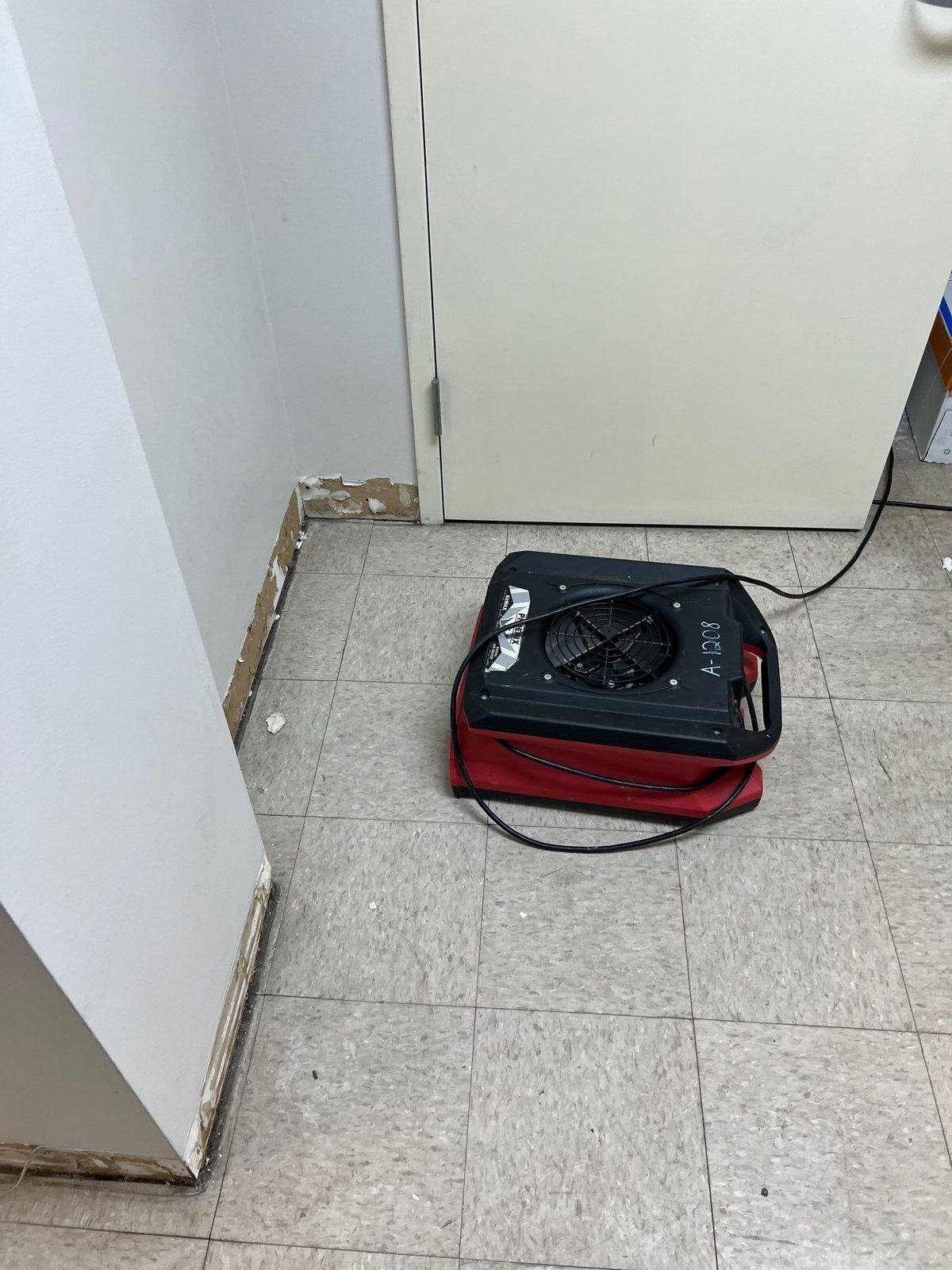
Wall cavity, baseboard, and cabinet drying
Walls and cabinets are where hidden water does the most damage, because they are built with hollow spaces and layered materials that trap moisture. Floors matter too, since water rarely stays in one layer. Here is how we approach each.
Wall cavity drying. Water that enters a wall does not stay at one height. It travels down inside the cavity and wicks up the drywall. We take readings at several heights to see how far it went. Where drywall is only damp and in good condition, we can often dry it in place by opening the cavity through small holes or by pulling the baseboard so air can move through. Where drywall is saturated, sagging, or was soaked by contaminated water, it is usually cut back so the framing behind it can dry.
Drying behind baseboards. Baseboards hide a gap where water collects at the bottom of a wall. We remove them, dry the space, and check the bottom plate and insulation. Solid wood trim can often be reinstalled after drying.
Drying under and behind cabinets. Water gets under cabinets and is trapped by the toe kick and the back panel. We open the toe kick and add air flow so cabinets can dry in place when their condition allows. Cabinet boxes made of particleboard swell and lose strength once they are soaked, so some cabinets cannot be saved. We tell you what the readings show before we recommend removal.
Floors and subfloors. Water spreads under flooring and into the subfloor, where you cannot see it. We check the flooring and the subfloor beneath it, and we direct airflow across the surface and, where needed, into the space below. Hardwood needs particular care because it can cup as it dries, and our hardwood floor water damage work covers those floors in more detail.
Across all four, we use moisture readings, backed by thermal imaging where it helps, and our water damage inspection is where those first readings are recorded.
Air movers, dehumidifiers, and containment
Drying equipment works as a system. Air movers create airflow across wet surfaces and pull moisture out of materials and into the air. Dehumidifiers take that moisture out of the air. Without both, the water simply moves around the building or settles back into the structure. Fans alone are not enough.
Placement matters as much as the equipment. We aim air movers at wet walls, under floors, and into cabinet spaces, and we set dehumidifiers so the air in the drying area stays dry. When an area is open to the rest of the house, containment helps. Plastic barriers around the wet area keep the dry air where the drying is happening and keep moisture from drifting into rooms that are still dry.
We check equipment at every visit, move it as parts of the structure dry out, and take it away when the readings show it is no longer needed. Drying equipment runs continuously, and it can be noisy. We explain what to expect before we set it up so nothing surprises you, and our water damage inspection determines how many machines a room needs.
While drying is underway, a few habits help. Keep doors and windows in the drying area closed so the equipment is working on the wet materials and not the outside air. Do not switch machines off or unplug them, even overnight, because drying stops when the equipment does. Keep children and pets out of the area, and tell us if a machine sounds different or stops running.
Moisture monitoring and drying goals
Drying without measuring is guesswork. We set a drying goal for each material by comparing wet areas with the moisture levels of the same material in an unaffected part of your building. That comparison tells us what dry looks like for your home, since a wood floor in a humid summer reads differently than one in winter.
At each visit we take moisture readings in the same locations, record the numbers, check the air with a humidity reading, and use thermal imaging to spot wet areas we might miss by touch. We adjust equipment if a spot is drying slowly. When the readings reach the goal, we take the equipment out. The drying log we keep is a record of what happened and when.
That record supports the next steps. Once drying goals are met, repairs can start on a dry, documented base. Our reconstruction services can handle repairs, or you can hand the records to the contractor of your choice. If you are working with an insurance company, the photos, readings, and drying logs are yours to share.
When demolition or reconstruction is required
Drying in place is the goal because it saves you the disruption of tearing things out. It is not always possible. Materials usually have to come out when:
- The water was contaminated, such as sewage or floodwater, and the material is porous
- The material sat saturated for a long time and has lost its shape or strength
- The material is the type that does not recover, such as wet insulation or swollen particleboard
- Mold is already present, or the material cannot dry before mold becomes a concern
- Drying in place would not reach the moisture trapped behind it
We do not decide this from the doorway. We show you the readings and photos and explain why a material can stay or has to go, so the decision is based on evidence. We cannot promise any material can be saved before we have inspected it.
When materials have to come out, the next phase is repair. We can plan the rebuild with you, since we also handle reconstruction, and the drying records show what was removed and why. The full scope of our water damage restoration covers everything from extraction through repair.
Call Sansara 24/7 Restoration & Remodeling for structural drying in St. Louis, MO
If your walls, floors, or cabinets have been wet, do not wait to see whether they dry on their own. Call Sansara 24/7 Restoration & Remodeling for structural drying in St. Louis, MO. We measure the moisture, set the equipment, monitor the drying, and document every step.
We are locally and family owned, based in Wildwood, and fully insured, and we answer every call at any hour. Estimates are free. Call (636) 812-3838, or use our contact form if the situation is not an emergency.