
Ceiling Water Damage Restoration in St. Louis, MO
A wet ceiling is a warning that water is above it, and a ceiling can come down without much notice. Sansara 24/7 Restoration & Remodeling provides ceiling water damage restoration in St. Louis, MO for homes and businesses. We answer the phone at any hour and get a crew moving.
Water reaches a ceiling in a few ways: a leaking or burst pipe above the room, an overflow upstairs, condensation from an HVAC line, a roof leak, or moisture that has been building above the drywall or plaster for a while. Whatever the route, the water spreads through the insulation and framing above the ceiling, then shows up as a stain, a sag, or a drip. Our job is the water damage. We find how far the moisture went, remove what is wet, dry what can be dried, and document the loss. Our water damage restoration services cover each step from the first inspection to repair planning.
Stopping the source comes first, and it is often a different trade. Repairing a supply line or drain is plumbing work, and repairing a roof is roofing work. Those are not trades we perform, so the source may need a plumber or a roofer. We handle everything the water damaged, and we work around their schedule so drying is not interrupted.
We respond to ceiling calls such as:
Stains that are spreading or still wet
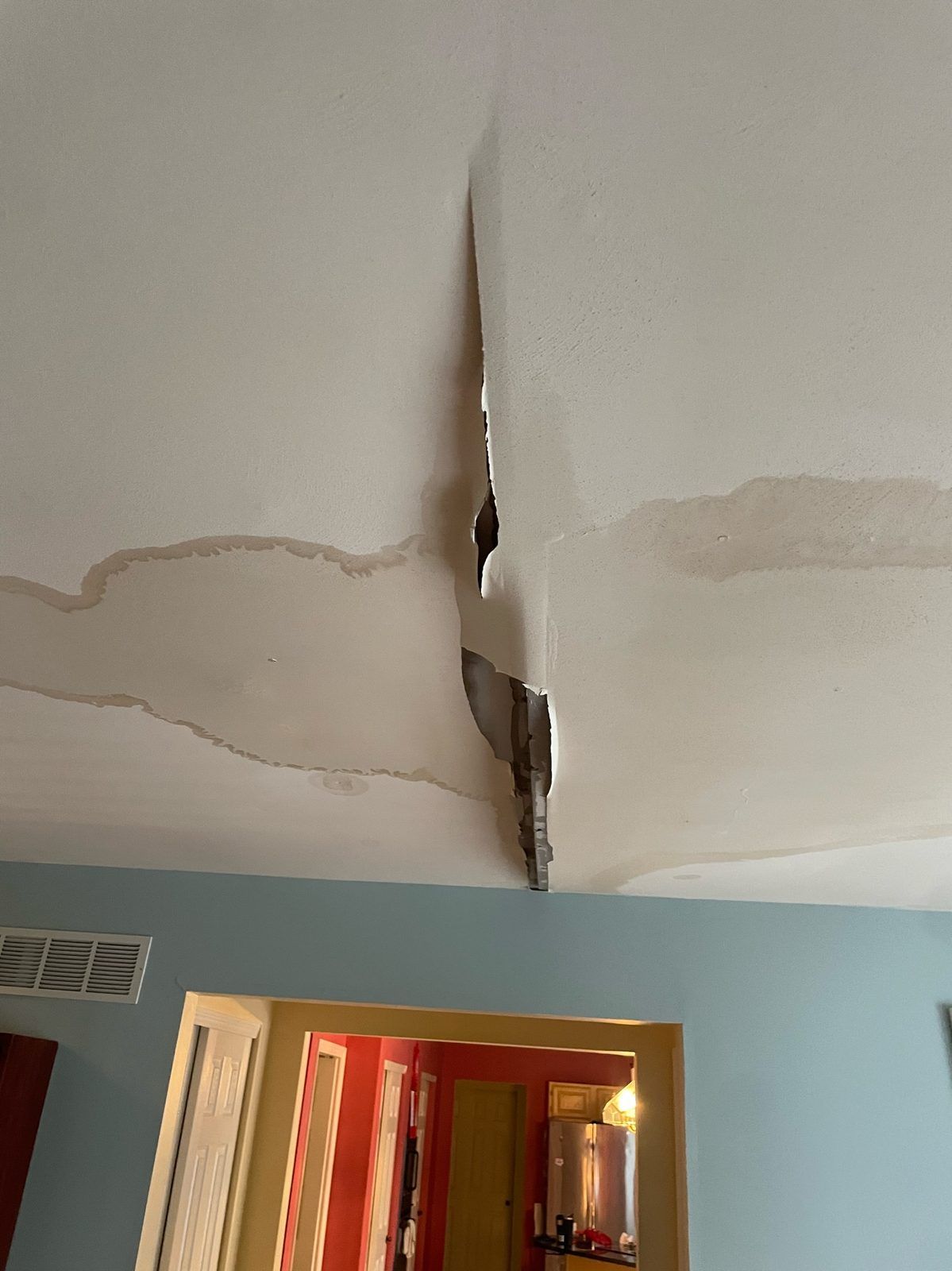
Ceilings that sag, bulge, or drip
Water coming through a light fixture, ceiling fan, or vent
Leaks from a pipe, tub, or shower above the room
Wet ceilings after a roof leak, and condensation from HVAC lines
Drywall or plaster that has partly or fully fallen
Signs ceiling water damage needs immediate help
Some ceiling stains are old and dry. Others mean water is still moving, and a few mean the ceiling could fail. Get help right away if you notice:
A ceiling that sags, bulges, or looks like it is holding water
Dripping, or water coming through a light fixture, ceiling fan, or vent
Stains that are growing, or dark rings that still feel damp
Paint that bubbles or peels, or drywall or plaster that feels soft or crumbly
Insulation or debris falling from the ceiling
A musty smell in the room below the stain
Safety comes first. Keep people and pets out from under a sagging ceiling, and stay away from water near light fixtures, fans, and wiring. If you can shut off power to that part of the house at the panel without stepping through water, do it. If you cannot, call an electrician. Please do not poke or cut into a bulging ceiling yourself. The water can come down all at once, and it may be near wiring. Our crew can open the ceiling in a controlled way to release the water and see what is above it.
The stain is rarely the whole story. Water travels along joists and pipes and can show up several feet from where it started. Take photos of the stain and any dripping before anything is moved, then let us map the wet area with a water damage inspection so you know how far it actually goes. If part of a ceiling has already fallen, keep everyone out of the room and call us. Debris removal and drying begin once the area is safe.
Common causes of wet ceilings
A wet ceiling always has a source above it, and finding that source is part of the job. These are the causes we see most often:
Pipe leaks. A burst, frozen, or leaking supply line in the floor or attic above the room. We cover sudden failures in more detail under burst pipe cleanup.
Bathroom overflows. A bathtub overflow or toilet overflow upstairs can soak the floor and drip through the ceiling below.
Appliance and water heater leaks. A washing machine overflow or a failed water heater on an upper floor or in an attic can do the same.
HVAC condensation. A clogged or failing condensate line, or a sweating duct, can leak into the ceiling below an attic unit.
Roof leaks. Worn flashing, missing shingles, and storm damage can let water in above the ceiling.
Attic condensation. Poor ventilation lets moisture collect on the underside of the roof and drip onto the insulation.
We use moisture meters and thermal imaging to trace a wet ceiling back through the space above it and see where the moisture starts, the same approach we describe for water leak detection. That shows how far the water traveled and gives you the information to call the right repair person. If the trail leads to a pipe or a fixture, a plumber makes that repair. If it leads to the roof, a roofer does, and if it leads to an HVAC line, an HVAC technician does. We do not perform those repairs, and we will tell you plainly what we found so you can hand it to the right person.
Drying, removal, and reconstruction decisions
Not every wet ceiling has to come down, and not every wet ceiling can be saved. The decision depends on how wet the material is, how long it has been wet, and what kind of water it was. We check with moisture meters before we decide, and we explain what we see. In general:
Drywall that is stained but firm and reads dry or close to dry may be dried in place.
Drywall or plaster that is sagging, soft, crumbling, or holding water generally has to come out. It is safer to take it down in a controlled way than to wait for it to fall.
Wet insulation above the ceiling is often removed so the framing can dry.
A ceiling that has been wet for a long time, or that was exposed to contaminated water, is more likely to need removal.
In severe cases, trapped water can bring a ceiling down, which is why we would rather open a bulging ceiling on our terms than have it fail on yours. When materials come out, we cut back to dry, sound material, then set air movers and dehumidifiers to dry the ceiling cavity and the framing. Our structural drying work continues until the readings show a normal, dry level. Only then does repair make sense.
Repair is a separate phase. Once the framing is dry, the ceiling needs new drywall or plaster repair, texture, and paint. Our reconstruction services can rebuild what we opened, so the team that dried your ceiling can plan the repair with you. We give you a clear scope first, and estimates are free.
Mold and insulation concerns above the ceiling
The space above a ceiling is where water hides. Insulation soaks up water like a sponge and holds it against the back of the drywall and the framing, where it dries slowly and out of sight. Wet insulation also loses much of its insulating value. That is why we check the space above the ceiling and often remove wet insulation, instead of repairing only the surface you can see. Older plaster ceilings need extra care too, because saturated plaster and lath are heavy and can hold moisture.
Mold needs moisture and something to feed on, and drywall paper, wood framing, and dust give it plenty. Under the right conditions it can begin to grow on damp materials within a day or two. Nobody can promise that mold will not develop after a ceiling leak, and we do not. We reduce the conditions mold needs by removing wet materials, drying the cavity thoroughly, and checking readings until they come down to a normal level.
If you see dark spots or growth on the ceiling, or smell a musty odor that will not fade, avoid disturbing it and let us take a look. Our mold remediation services cover mold once it has been confirmed, and we will tell you plainly whether what we see calls for that.
Documentation for insurance and repairs
Ceiling losses often involve more than one party: whoever repairs the source, whoever repairs the ceiling, and your insurance company. Good records help all of them. Throughout the job we document the loss with photos, moisture readings, drying records, and an itemized scope of the work.
Photograph the stain, the ceiling, and any water before anything is moved, and keep the paperwork from the source repair, such as a plumber's or roofer's invoice with a note on what failed. Whether insurance covers a ceiling loss depends on your policy and the cause, and that is a question for your insurance company. We work with your insurance company by sharing our documentation, and we do not promise claim approval or coverage.
We also write the repair scope so it is useful: what was removed and why, what has to be rebuilt, and in what order. Our reconstruction team can then carry out the ceiling repair, so you are working from one scope instead of several.
Call Sansara 24/7 Restoration & Remodeling for ceiling water damage in St. Louis, MO
Call Sansara 24/7 Restoration & Remodeling for Ceiling Water Damage in St. Louis, MO at (636) 812-3838. We answer 24 hours a day, and we start on the water damage while your plumber or roofer handles the source.
We are locally and family owned, based in Wildwood, and we serve homes and businesses across St. Louis City and County, St. Charles County, Jefferson County, Franklin County, and Monroe County, Illinois. Estimates are free. If the ceiling looks stable and you would like it checked, send a request through our contact form and we will follow up. Everything we do for a wet ceiling sits within our full water damage restoration services, from inspection through drying and rebuilding.